The Square Root of 2, a story of Irrational Numbers and Paper Sizes

But then still one issue remains… What on earth is $\sqrt{2}$? Based on the fact that $c^2=2>1$ means that it should at least be larger than $1$, but what is it exactly? It does not seem to be a whole number. Which number squared gives $2$? Is it a fraction? Can it be written as one? Just typing this into our calculator doesn’t seem to clear out this issue right?
Apparently it was very difficult for ancient civilizations to get around this problem of not finding the exact value of $\sqrt{2}$. Archaeological work has shown that various approximations of the square root of 2 have been used by these early civilizations. The Babylonian tablet, classified as YBC 7289, had $\sqrt{2}$ accurate to $5$ decimal places. All this fog cleared up when a result on the nature $\sqrt{2}$ was finally found. It goes as follows:
Suppose $\sqrt{2} = \frac{p}{q}$, where $p$ and $q$ are integers with no common factors. Let’s first square both sides: $$2 = \frac{p^2}{q^2} \rightarrow p^2 = 2q^2$$ This means that $p^2$ is an even number because it equals $2q^2$ which is divisible by $2$. An even number is a number that can be written in the form $2n$ where $n$ is any whole number. However, this means that $p$ itself should also be even. Because squaring an even number always results in an even number. If this is not clear, feel free to try to see this for yourself.
This means that for a whole number $k$ we can say that $p=2k$. This will result in: $$p^2=4k^2 = 2q^2 \rightarrow 2q^2 = 4k^2 \rightarrow q^2 = 2k^2$$ Following our reasoning from before this would mean that $q^2$ even, so $q$ is even too. But wait a second, if both $p$ and $q$ are even, they share a factor of $2$. That contradicts our starting assumption. We literally said in the beginning of this complete reasoning that $p$ and $q$ are integers with no common factors.
Something went wrong along the way. Because all what we did up until now was correct it should be our starting assumption that is wrong. This is actually a common technique for constructing proofs in math. The general idea is to just make up a setting and work it out in full until a contradiction arises which then will prove or disprove a certain statement.
In this case, the contradiction leads to a proof of the statement that $\sqrt{2}$ can’t be expressed as a fraction. Hence, it is irrational.
The discovery of $\sqrt{2}$ being irrational shook the ancient world. Maybe this does not to seem something crazy but think about it this way: some fractions have repeating decimal expansions, the simplest example is $\frac{1}{3}=0,33333\cdots$. However, they are still tame as we still can understand them using two numbers, namely the numerator and the denominator. But in the case of $\sqrt{2}$ or $\pi$ which is also an irrational number, there is no simple way to save it fully in a computer for example. Both numbers will extend after the comma without any ending. There is no fraction that works. Their decimal expansions go on forever, with no pattern and no way to capture them completely, even a computer can only approximate them. First time thinking about it makes your head kind of hurt. How can such a simple geometric question lead to such deep things?
In addition to it, actually computing $\sqrt{2}$ or $\pi$ has their own math which is something for a future post. For readers curious to go deeper, the following formula is a way of computing $\sqrt{2}$.
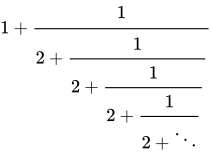
In this case, as all numbers present in the continued fraction are positive definitely the second solution will correspond to what is actually represented by the continued fraction. Let’s fill it into the original equation. $$ 1 + \frac{1}{ 1+ \sqrt{2}} $$ This is still not too nice but we can use a trick. We can multiply both the numerator and the denominator with $1 - \sqrt{2}$. Using algebra we know that $(a-b)(a+b) = a^2 – b^2$. Again, if you are not convinced feel free to try this yourself.
Why should we care? Well we get rid of the dirty $\sqrt{2}$ in the denominator. Let’s see what happens. $$ 1 + \frac{1}{ 1+ \sqrt{2}} $$ $$ =1 + \frac{1}{ 1+ \sqrt{2}} \frac{1-\sqrt{2}}{ 1- \sqrt{2}} $$ $$ =1 + \frac{1-\sqrt{2}}{ 1-2}$$ $$ =1 – (1-\sqrt{2})$$ $$ = \sqrt{2}$$ Beautiful isn’t it?
The Pythagoreans believed only in whole numbers or simple ratios like $\frac{2}{3}$ or $\frac{5}{4}$. To them, $\sqrt{2}$ was a monster as it was an illustration that not everything in the universe could be neatly explained by ratios.
Little is known with certainty about the time or circumstances of this discovery, but the name of Hippasus of Metapontum is often mentioned. For a while, the Pythagoreans treated as an official secret the discovery that the square root of two is irrational, and, according to the legend, Hippasus was murdered for exposing the secret, though this has little to any substantial evidence in traditional historian practice. Whether or not that story is true, it shows how shocking the discovery was. It is undeniable that $\sqrt{2}$ was humanity’s first encounter with a number that didn’t fit into the safe, familiar world of fractions.
Just like many huge scientific discoveries, the discovery of irrational numbers was unsettling to mathematicians at the time. The upcoming of irrational numbers expanded the meaning of numbers and forced mathematicians to go beyond fractions and develop new ways of thinking. This laid the foundation for future developments which explains why the proof of its irrationality comes up in every class.
Furthermore, apart from the fundamentals of math and geometry, $\sqrt{2}$ also shows up in paper sizes. In 1786, German physics professor Georg Christoph Lichtenberg found that any sheet of paper whose long edge is $\sqrt{2}$ times longer than its short edge could be folded in half along the longest side and still be of similar proportion as the original paper.
Consider the ratio $R$ between the long side $L$ and the short side $S$. $$ R = \frac{L}{S} = \sqrt{2}$$ Then by halving the original long side the original short side becomes the long side which means that the new dimensions can be expressed as $S’ = \frac{L}{2}$ and $L’ = S$. $$ R’ = \frac{L’}{S’} = \frac{S}{\frac{L}{2}} = 2 \frac{S}{L} =\frac{2}{\sqrt{2}} = \sqrt{2}$$ This means simply that having such a ratio of lengths of the longer over the shorter side guarantees that cutting a sheet in half along the longest line results in the smaller sheets having the same ratio as the original sheet.
Centuries later, this paper ratio was used in the beginning of the 20th century to create the "A" series which has then been the global standard for business documents. A fun party trick to tell your friends is that each paper size of the "A" series has the same proportions with aspect ratio $1:\sqrt{2}$.


Comments
Post a Comment